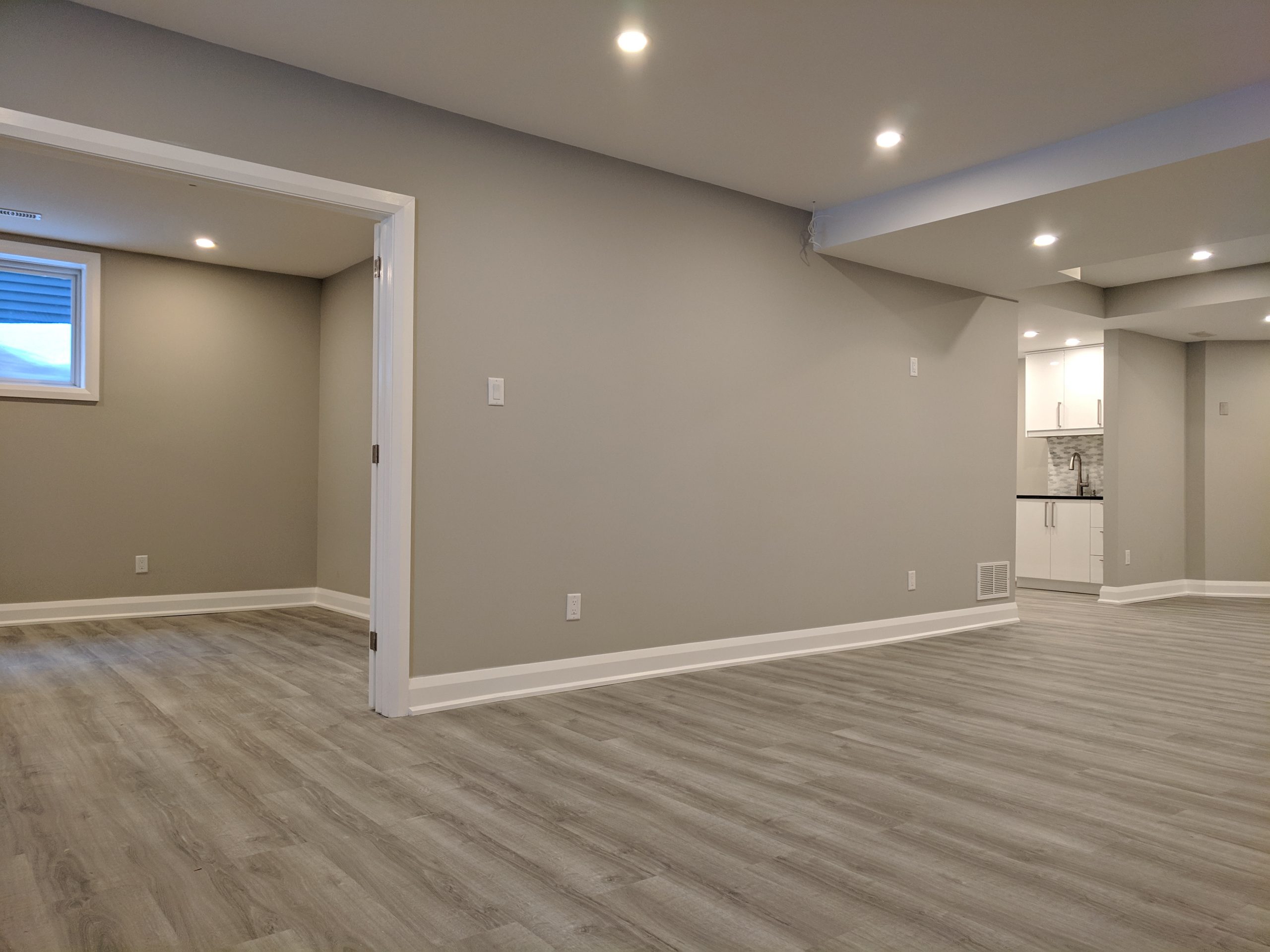
The fastest — and most accurate — way to frame basement walls is to build them flat on the floor and tilt them up into position. It sounds simple, but there are a few non-negotiable rules that separate a solid, code-compliant wall from one that causes problems down the road.
🏗 Rather have a pro handle it? ILux Construction frames basements across Ontario using this exact method — fast, code-compliant, and built to last.
📞 Get a free quote → contact@iluxconstruction.com
The 3 Rules of Fast, Accurate Basement Framing
Rule 1: Always Frame 16 Inches On Centre (OC)
Studs go every 16 inches, measured from edge to edge. Most tape measures mark these intervals in red to make it easy. This matters because every standard 4×8 sheet of drywall is designed to land perfectly in the middle of a stud at 16” OC. Deviate from this and you’ll be cutting drywall around gaps all day.
Rule 2: Best Practice — Pressure-Treated Lumber for the Bottom Plate
Using pressure-treated lumber for any plate that sits on or near concrete is strongly recommended and is standard practice across Ontario. The OBC (Section 9.23.2.2) permits untreated lumber when a continuous impermeable moisture barrier separates it from the concrete — and that’s exactly what your sill gasket does. That said, combining pressure-treated lumber with a sill gasket gives you the most durable, inspector-friendly result and is what most contractors specify.
Important: pressure-treated lumber is corrosive to standard nails. Always use galvanized (ACQ-rated) fasteners throughout.
Rule 3: Cut Studs Slightly Short
Make your studs a few millimetres shorter than the actual floor-to-ceiling height. This gives you clearance to tilt the assembled wall up off the floor without it binding against the joists above. Fasten the top plate with screws — not nails — so you can make micro-adjustments as you plumb the wall.
Step-by-Step: Floor Assembly and Tilt-Up
- Lay your top and bottom plates side by side on the floor, separated by the length of your studs.
- Mark stud positions at 16″ OC on both plates simultaneously so they line up perfectly.
- Nail studs between the plates using your milled-face hammer to straighten any warped lumber as you go.
- Tilt the assembled wall up, slide it into position, and prop it temporarily.
- Use your laser level to plumb the wall, then fasten the top plate to the joists above with screws.
- Anchor the bottom plate to the concrete using your Ramset every 24 inches. Wear ear protection.
😤 Dealing with a complicated layout?
Awkward corners, load-bearing walls, uneven slabs — our team has seen it all. ILux Construction solves tricky basements across Ontario.
📋 Book a free on-site assessment → contact@iluxconstruction.com